Posted by Control Concepts USA on | Comments Off on The Hidden Cost of Ineffective Material Flow Aids
Flow aids can resolve bridging, arching, and other material blocks, but many give limited results and come with hidden costs. So instead of solving the problem, they can even create new ones—and hinder productivity and revenue.
Hammers and Manual Cleaning
Hammers are the cheapest flow aid you can possibly find… or so you think. While you can get a hammer for less than $20, you’re actually paying for manpower hours and the downtime while workers clear out the clogged material from the vessel.
That can be very expensive. One of the biggest cement companies in Southeast Asia calculated that they lost $12,000 per hour of downtime. In North America, this downtime is more like $25,000 an hour.
Hammering can also damage machines, and it creates the risk of worker injury. It’s also very inefficient: material can still cling to vessel walls compromising product consistency and even leading to spoilage.
Fluidizers
Fluidizers are sometimes the default flow aid because they have already been pre-fitted into the vessel. The rubber disks are connected to air piping and use a combination of gentle vibration and aeration to activate the material.
While the fluidizers work for very light powders like flour, they can’t activate heavy, damp, or sticky materials. They have a small effective radius, so you may need to install several units. Since the disks run continuously, energy consumption is also high.
Fluidizers that are installed inside the vessel can also degrade, and material can be trapped inside the disks. This is a risk for sanitary processes and it creates cleaning and maintenance challenges.
Industrial Vibrators
Vibrators, as the name implies, vibrate the material to shake it free from the vessel wall and collapse any bridging and blocks.
However, many materials can actually become more compact when it is shaken. In fact, vibrators are sometimes used to compress materials before they are stored or transported. That’s effective in a warehouse, but not in a silo or hopper where you want materials to move.
Even for materials to respond to vibration, this flow aid can still be problematic. It can cause metal fatigue and eventually lead to vessel damage. It uses a lot of air and energy to operate. It does not completely flush material that clings to walls or pipes, so you will still need to do periodic shutdowns for cleaning.
Air Cannons
This flow aid blasts air through material blocks. While powerful, it is not always effective. Air can channel through the holes and diminish its effect. It requires a large amount of plant air and energy to operate, and will still leave a lot of material on the vessel that needs to be manually cleaned.
The large units are also difficult to install in small vessels, and the metal recoil contributes to vessel wear and tear. Flying material can also enter the nozzle and solenoid valve, so the system is prone to damage and maintenance issues.
How to Find the Most Efficient Flow Aid
When selecting a flow aid, don’t just look at the initial cost of installation. Look at the hidden costs—downtime and manual labor, consumption of energy and plant air, cleaning and maintenance, and even the financial and legal impact of a worker injury.
To avoid these costs, select a flow aid based on these factors:
Speed and efficiency. How fast will your material flow? Will it shorten your production time? Can the flow aid remove all stagnant material, or will you still need to hammer or manually clean your vessels?
Operating costs. How much energy does it consume during operation? Does it use energy efficiently, i.e. will the units run continuously or in short, specific durations? What is the cost of cleaning and maintaining the flow aid itself, and how does it impact the maintenance of the vessel in which it is installed?
Hygiene and safety. Consider risks to your product quality (like material contamination and spoilage) and risks to your people (worker injuries during manual cleaning, etc.).
Companies Choose AirSweep as the Most Cost-Effective Flow Aid
Many plants that used fluidizers, vibrators, and other flow aids eventually switched to AirSweep because they got better results. It improved productivity, product quality, and had lower energy and maintenance costs.
If you have any other questions about AirSweep or need more information about how it can work on your process, contact us for a personal consultation or customized proposal.
Posted by Control Concepts USA on | Comments Off on DAZIC Zero Speed Switches Prevents Tons of Problems
What would happen if your conveyor system suddenly malfunctioned, and dumped all of your material on the ground? How long would it take you to clean it up?
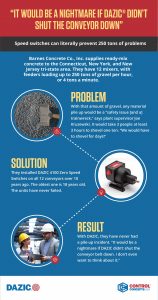
A cement manufacturer whose feeder loads up to 250 tons of gravel per hour knows that if a machine fails, any delay in response time means hours of backbreaking cleanup. Even just a 10-minute delay could result in 30 hours of downtime.
DAZIC Zero Speed Switches can help prevent material pileup and detect machine failure saving you time and money.
The cement manufacturer used DAZIC to prevent tons of problems. Their DAZIC solution costs less than $1,000 and hasn’t failed them once in the last decade. Read their story – and reach out to us if you’d like to have one installed in your plant.
Posted by Control Concepts USA on | Comments Off on Meet Safety Regulations with DAZIC Zero Speed Switches
What could happen if one of your equipment malfunctions, and tons of material spill before you’re able to shut it off?
The obvious problem would be the loss of production. You could spend hours, if not days, cleaning up the mess. You may even have to pull workers from other parts of the plant to get the job done faster or hire other people.
But the biggest and most expensive risk that you make is a violation of safety regulations.
Can a worker be injured if he is buried under the material, or exposed to it?
Does the material have hazardous properties? (Ex. can cause fires, chemical burns, health problems, etc.)
Is the worker trained to personally handle and move the material? Does he know the proper safety precautions, and has he been given the proper safety equipment and gear?
Is this part of his job description? Any task assigned to a worker outside of what he is trained to do increases the risk of injury.
The Occupational Safety and Health Administration (OSHA) has different levels of safety violations. However, the most serious violation is “When a business owner or manager knows there is a hazard that can result in injury or death and does nothing to resolve it.” Fines can reach up to $14,502 for each one, and willful or repeated violations can get stiffer penalties up to $145,207.
Use DAZIC Zero Speed Switches to Meet Safety Regulations
A DAZIC Zero Speed Switch can help prevent material pileups and detect machine failure. Just like fire alarms, they are cheap, easy to install, and can quickly alert you of a problem.
Speed switches are attached to any equipment that has rotating shafts. The sensors can detect if the rotations per minute (RPM) do not match the speed trip-points that you have set – either it is moving too fast, too slow, or stopped completely. It triggers an alarm and shuts it down.
Several plants around the world have installed DAZIC Zero Speed Switches to prevent worker injury and meet strict industry safety protocols.
Flammable Environments
Some fine powders can form explosive mixtures when released into the air, which can lead to flash fires. The Occupational Safety and Health Administration (OSHA) has classified these materials as combustible dusts.
Under OSHA regulations, companies that use these materials must have dust control measures that prevent the accumulation of the dust during daily operations, and an emergency action plan in case the dust collects or is accidentally dispersed.
One of the world’s largest rubber tire manufacturers uses carbon black—classified as a combustible dust—to improve durability and performance. They installed DAZIC Zero Speed Switches to prevent any material spills and meet OSHA safety standards.
Physical Injury
Some industries—like cement, mining, or minerals processing—work with very heavy bulk solids. If any of the equipment fails, workers would have to clear the material before production can resume. However, contact with any material outside of normal operations can have its own risks.
The type and level of hazards depend on the material properties and the process. However, scenarios can include:
Physical injury from lifting heavy material, or being hit by debris
Respiratory problems from inhalation of dust and fine powders
Skin irritation, ranging from rashes to chemical burns
Knowing these risks, a ready-mix concrete manufacturer installed DAZIC Zero Speed Switches to prevent material pile-up. They have 12 mixers, with feeders that load up to 250 tons of gravel an hour.
While they are a local business with limited budgets, the DAZIC Zero Speed Switches were an inexpensive investment that has prevented workplace accidents and very expensive regulatory fines. “It’s really a safety issue,” said plant supervisor Joe Kruzewski. “It would be a train wreck [to be] buried with that amount of gravel.”
The DAZIC Zero Speed Switches are also very durable. The oldest one is 18 years old, and it is still working.
More Information
To learn more about how DAZIC works watch this video. Are you looking to meet safety regulations in your plant? Contact us and meet your safety regulations with DAZIC.
Posted by Control Concepts USA on | Comments Off on AirSweep in the Mined Materials Industry
AirSweep is used in the mined materials industry. Nearly all manufacturing processes use mineral commodities. The smartphone you use daily (including its display and circuits) is made from at least 14 mined materials.
Unfortunately, mineral commodities are notoriously difficult to handle. They bridge, arch, and interlock. These bulk material blocks can be as stubborn as a rock—literally.
But AirSweep has solved this problem every single time. See it for yourself with the case studies and flow tests on our mined materials industry page. The Airsweep bulk material flow system works better than vibrators, bin activators, and air cannons on heavy materials. If that isn’t enough, AirSweep costs less to operate too!
What’s your toughest, most problematic flow problem? Contact us and we’ll find a way to fix it.
Posted by Control Concepts USA on | Comments Off on AirSweep VS Air Cannon Management Style
Do you have an AirSweep or air cannon management style? The air cannon is like the obnoxious co-worker who’s really loud and loves to throw his weight around. But despite all its hot air, it makes a mess that somebody else has to clean up.
AirSweep is the manager that quietly gets things done. It puts pressure where it’s needed, to keep things flowing and the process going. It reduces stress, and never leaves a mess.
Posted by Control Concepts USA on | Comments Off on DAZIC: Mining and Processing of Mined Materials
Mined industrial materials are used to make thousands of commodities: building materials, electronics, detergents, medications, plastics, ceramics, paper, glass, and many more. Some minerals are used in processes — such as bentonite for gas and oil extraction, and kaolin for fracking operations.
Many production facilities will process tons of mined materials a day. For example, Barnes Concrete Co. is a manufacturer of ready-mix concrete based in the Connecticut, New York, and New Jersey tri-state area. In just one hour, up to 250 tons of gravel are loaded into their feeders. Imagine the kind of volume in much larger companies that have more products and wider distribution.
Problems and Risks
Working with high volumes of heavy materials can cause several problems in production that can cost millions of dollars if it is not properly managed. Any failure in equipment can lead to tons of materials being spilled—causing delay and possibly injury.
If companies do not manage this risk by incorporating safety devices, they are vulnerable to serious and long-term financial and legal problems.
Safety Compliance
Regulatory bodies such as the Occupational Safety and Health Administration (OSHA) require employers to keep the workplace—whether it is the mining or the processing facility—free of serious recognized hazards.
If a plant inspection reveals negligence or failure to comply, the company can be slapped with large fines and a suspension of its business license.
Production Delays
Barnes Concrete Co.’s plant supervisor Joe Kruzewski estimates that if there were any material spills, it would take three people at least three hours to shovel one ton of gravel.
Since the feeder loads 250 tons of gravel per hour, or about four tons a minute, even a 10-minute delay in response time after a machine fails could result in 30 hours of downtime. “We would have to shovel for days!”
Worker Injury
Manually shoveling heavy material also creates another problem: worker safety. Any work that is outside of what a worker is trained and hired to do increases the risk of injury. Other minerals can also be dangerous if they are spilled, because of the weight, creation of flammable or other hazardous environments, or health problems caused by exposure to either the mineral or the chemical compounds combined with it.
Any worker accident can incur both direct and indirect costs. Direct costs include regulatory fines, hospital and litigation costs, and insurance penalties. Indirect costs can be even larger, because of loss of business contracts and long-term damage to reputation.
Manage Risks with a DAZIC® Zero Speed Switch
Barnes Concrete Co. has never had any incidents of material spills because of a simple safety device: the DAZIC Zero Speed Switch.
DAZIC Zero Speed Switches are interlocked into a conveyor system so that operations stop if any equipment runs outside of pre-set speed limits. It prevents material pile-up and all of its disastrous consequences.
They installed the DAZIC Zero Speed Switches on all of their 12 conveyors several years ago. The oldest one is 18 years old, and it is still working.
At that time, Barnes Concrete Co. was still a smaller company with a limited budget for equipment investment. However, the DAZIC Zero Speed Switches cost less than $900 each—a very affordable investment that has paid off.
“It’s really a safety issue,” said Kruzewski. “Any equipment malfunction or failure in the production line could lead to an avalanche of material. It would be a trainwreck [to be] buried with that amount of gravel.”
The speed switches have also proven to be very durable and reliable. “They have never quit. The mounting eventually fails from wear and tear, but that’s more of maintenance on our part, not from the unit failing,” says Kruzewski.
How a DAZIC works
DAZIC Zero Speed Switches are used by both small, local businesses and industry leaders that operate all across the globe.
To find more information on how DAZIC works, visit the product page, which has a simple video explaining its operations, and the different models that can meet your process needs.
You can also contact us for consultation, where we can answer your questions and customize a proposal.
Posted by Control Concepts USA on | Comments Off on How to Reduce Material Handling Costs
Plants can manage tons of bulk powders and solids every month. In order to manage production costs, it is important to efficiently store, move, and process the materials without waste or delays.
However, many materials have intrinsic properties that can affect how they react to the environment or flow in a vessel. Powders can settle in storage or draw moisture to form clumps. Particles can segregate, and moist or heavy materials can cling to equipment. Bridging and ratholing are also very common.
Improve material handling efficiency
AirSweep pneumatic flow aids can prevent many problems that can increase material handling costs. Its powerful air pulses promote on-demand, first in/first out flow. It is effective for tough materials and has been proven to be more effective than vibrators, fluidizers, and other kinds of flow aids.
Many companies have used AirSweep to reduce material handling costs. One client even said, “The AirSweep paid for itself in just two weeks!”
Reduce waste
A food company that uses flax and cocoa powder had to throw away up to 40 pounds of mixture a day and even had to pay to have it hauled away.
When they tried using vibrators and fluidizers, they not only spent more on energy consumption, but also had to spend one hour each day manually clearing out residue with sticks and hammers. However, AirSweep was able to solve 90% of the material retention problem, which significantly increased production and reduced waste.
Increase production speed
Poor material flow can affect production efficiency and the overall output of the plant. One paint company had issues with titanium dioxide, a fine powder that has a tendency to segregate. Since it did not completely empty out during the batch cycle, it would take 50 minutes to transport it a distance of 325 feet.
However, with the AirSweep system, the paint company was able to shorten batch time to 15 minutes.
Prevent spoilage
Stagnant material that is left in the vessel can spoil or affect product size, color, and texture. In order to protect quality and safety, and maintain a consistent formula, it is important for materials to achieve first in/first out flow.
One of the world’s largest manufacturers of infant formulas trusts AirSweep to flush material build-up between production runs of regular and lactose-free milk. The USDA-accepted model also meets sanitation requirements and is so effective that it reduced cleaning time from 40 hours to 10 hours.
Prevent equipment damage
To reduce material handling costs, plants need to choose a flow aid that will not cause structural stress on the vessels. Hammering leaves deep dents and cracks, and air cannons and vibrators cause metal fatigue. Eventually, the vessel will need to be repaired or even replaced.
In contrast, AirSweep does not damage vessels, and can even be used on vessels with very thin walls.
Use energy efficiently
Another key factor in reducing material handling costs is to use energy-efficient equipment.
Though it taps the same level of air pressure as fluidizers and air vibrators, the AirSweep system does not run continuously. It starts and stops with the discharge cycle, and runs in a sequence with one pulse at a time. So overall, it uses less plant air and electricity than flow aids that run continuously.
The energy savings can be very significant for plants located in countries that have a high cost of electricity—such as this cement company in the Philippines.
AirSweep: the most cost-effective flow aid
The AirSweep system can improve material flow and prevent material handling costs. Contact us to find out more about how you can use AirSweep in your process.
Posted by Control Concepts USA on | Comments Off on AirSweep in the Food Industry
Product quality and safety are critical to the food industry. Product recalls can cause millions of dollars, permanently destroy brand reputation, and can even civil and criminal liabilities.
Unfortunately, the rate of food recalls is increasing, and can be one of the biggest threats to a food company’s profitability, says Food & Safety Magazine.
The cost of product recalls
According to the Grocery Manufacturers Association (GMA) in the United States, food recalls cost companies an average of $10 million in direct costs, and even larger indirect costs from lost sales, insurance, lawsuits, and compliance penalties. The following are some indirect costs a company can experience:
Stopping production
Removing and destroying contaminated products
Investigating and testing to identify the source of the problem—as well as other recall tasks that will require additional manpower and technology
Lost sales from pulling both contaminated products and even the entire product range
Insurance impacts, including increased annual fees and possible cancellation of the plan
Legal fees, settlements, and damages
Penalties from regulatory boards, including fines, shutting down of operations, suspension of registration
Drop in the company’s stock value
Aside from this, a company will often suffer a media backlash, intense public scrutiny, and overall loss of brand confidence. Customers may decide to switch to another product, or even avoid all products by the manufacturer.
This can lead to a long-term sales depression that can take years to shake off, and only with an extensive marketing and public relations campaign.
Quality control requires material control
Poor material flow can have a huge impact on product quality and safety. Stagnant material can become spoiled and rancid, and develop mold, bacteria, and other microorganisms. Inconsistent flow can cause inconsistent flavor, texture, and nutritional value.
However, many food materials have inherently problematic flow properties. Powders can bind to form a cohesive arch. Flax, cocoa or other materials with a high fat content can cake or clog pipes or filters. Other materials can also settle during storage, and absorb moisture from the air to form hard clumps.
So to get their process going—and ensure that they get first in, first out flow—food companies need a reliable material flow aid like AirSweep.
AirSweep in the Food Industry
AirSweep’s powerful bursts of compressed air sweep stagnant material back into the flow stream, and flush the vessel completely clean. It improves productivity, saves time and money from manual hammering and cleaning, and protects product quality.
A commercial bakery had issues with flax oils caking in the discharge up to the filters. They had to throw away 40 pounds of mixture a day, and even had to pay to have it hauled away. Vibrators hardened the discharge—“practically turned the flax into concrete,” the maintenance head described. Fluidizers were too weak to activate the material. AirSweep was the only material flow aid that worked. “’it gets 10 out of 10!”
A spice manufacturer also uses AirSweep to clean its flush ribbon blenders between batch runs. The system has helped them save $200,000 from flushing material alone.
By pulsing the AirSweep units during and after the batch runs, they found that the powerful air pulses swept the vessel walls and inner surfaces of residual powder buildup. This made a significant, positive impact on blend uniformity and dramatically lessened the labor and time needed to clean after the batch runs were completed. This allowed them to add batch runs and increase production output.
Proven effective for the food industry
AirSweep is used in the factories of some of the biggest food manufacturers in Asia and North America, and has been proven for various bulk solids and powders, including:
The AirSweep USDA-accepted models are specially designed to meet the highest standards of sanitation and hygiene. The air-tight nozzle prevents material retention and bacterial growth, and the modular construction is made for easy cleaning and inspection. For convenience, the tri-flange mount allows removal without tools.
Contact us for more information about the use of AirSweep in the food industry, and the best system for your needs.
Posted by Control Concepts USA on | Comments Off on AirSweep Installation FAQs
AirSweep can solve even the most challenging material flow problems—and it’s so easy to install and maintain too. The system can be set up in just a few days and can be attached with simple tools on any kind of vessel.
Here are some of the most frequently asked questions that people ask about installing an AirSweep system and integrating it into their process.
Where is the AirSweep Installed?
AirSweep is attached outside of the vessel. Only the nozzle tip comes in direct contact with the material, and the nozzle closes after each short pulse to minimize material feedback. This makes the system more hygienic and prevents damage to the rest of the system.
How is the AirSweep Installed?
AirSweep can be installed in four simple steps.
CUT holes where the couplings will be welded. It can also be retrofitted into existing holes in vessels that previously used other flow aids.
WELD the couplings into place
INSTALL the AirSweep by threading into coupling, and tightening the lock nut once the proper insertion depth is reached.
CONNECT the pulse valve with a flex hose to a rigid header that connects to the air supply
The only tricky part is aligning the vessel, and making sure that the nozzle reaches the proper depth. This video demonstrates it clearly.
Is There an Option to Install AirSweep Without Welding It to the Vessel?
You can use the AirSweep outside-in mounting bracket. The kit has all the parts you need, and it can be installed with just a spanner wrench and a small 1-3/8″ diameter hole.
The brackets are available in three sizes, to accommodate the different models. This option is available for all AirSweep models: VA-06 for small vessels, VA-12 for medium to large vessels, and VA-51 for large vessels.
The bracket is recommended for people who want to:
Minimize modifications to the vessel
Easily remove the nozzle for cleaning
Install the flow aid as quickly as possible
Can AirSweep Be Installed on Different Kinds of Vessels?
Yes. AirSweep can be installed in any vessel or area where material has a tendency to hang up. Aside from silos, hoppers, and other material storage containers, it can be placed in gravity chutes, fine grinding mills, extruders, pneumatic convey lines, cyclones, pipes (including elbows and bends), cyclones, and more.
AirSweep can also be installed on:
Thin vessels that would normally be damaged by agitators, vibrators, or air cannons
Concrete vessels
Very small vessels—even as small as 300 millimeters
Very large vessels
In short, AirSweep can work on any type, size, and material of vessel. We just adjust the system’s pressure and pulse frequency to accommodate any constraints.
How Do I Prepare the Vessel Before Installation?
You do not need to make any changes to the vessel before installing the AirSweep system. It does not require any vessel coating or lining to work. It has such powerful activation that it can move material even on a rough surface.
If your vessel has material, empty it out below the level of where you are installing the nozzle. It can prevent material from spilling while you are drilling the hole and welding on the couplings. However, if you are using aggregate material that won’t spill out, you can actually install the units on a full vessel—if you don’t mind the installation debris.
If sanitation or contamination is a concern, clean out the debris with water or flushing material. You can also use high-pressure cleaning since it won’t affect the AirSweep in any way. The air nozzles are tightly sealed and no water can get in them. In this video, we actually submerged the unit in water to demonstrate its dust-tight, waterproof design.
What Kind of Air Supply Do We Need?
AirSweep can work with any type of pressurized plant air. We recommend treating the air before it goes to the system to avoid introducing moisture into the product.
The key factor is not the type of air that is used but maintaining the correct air pressure and volume. This video explains why.
Where Should I Place the AirSweep Units?
It depends on your material and process. Our engineers will analyze your material flow problem, recommend the best solutions, and then provide a diagram that shows the proper placement, air pressure, and pulse frequency and intervals.
They can also answer any questions you may have about installation—and typically reply in one business day. You can also find the installation guides for your AirSweep model, or watch the installation videos.
Contact us if you have any questions about AirSweep and how it can be integrated into your process.
Posted by Control Concepts USA on | Comments Off on 7 Companies that Switched from Vibrators to AirSweep
Have you ever shaken a ketchup bottle because the ketchup was stuck? Industrial vibrators work the same way. The movement breaks apart the material and loosens it from the vessel walls.
But as you’ve probably noticed, there will always be a little bit of ketchup left in the bottle. Vibration can never completely flush a vessel completely clean, especially if the material is damp or dense.
In some cases, industrial vibrators can actually make the material more compact, which is why it is sometimes used to compress materials before packaging. But as a material flow aid, it has limited capability and a lot of trade-offs—such as the need to manually clean material residue, or repair vessels because of metal fatigue.
That’s why many companies who tried industrial vibrators looked for a more effective solution, and found it in AirSweep.
Food Industry
To prevent spoilage, food manufacturers need to achieve first in/first out, on-demand flow. Any stagnant material can degrade and contaminate an entire batch.
The food industry also works with materials with problematic flow properties which don’t respond well to vibration.
Dense, Sticky Materials
Ingredients with a high-fat content will stick to vessel walls, and form a dense bridge or arch that cuts off the flow of material.
A cheese company had similar issues with protein concentrate (WPC). Vibrators only packed the sticky material and worsened the problem. Unfortunately, the stagnant material sparked a fire in their baghouses, creating an urgent safety concern.
They switched to the USDA-accepted AirSweep system. The powerful air pulses sliced through the blocks just like an “air knife”, leaving no residue that could compromise both plant safety and product quality. They now use AirSweep in all their plants in the United States.
Fine Powders
A candy manufacturer processes hundreds of pounds of cocoa a day. However, production would stall because the fine powder would pack, bridge and rathole in the hoppers. They tried vibrators, fluidizers and bin aerators—all of which failed. Workers still had to scrape the vessels every 3 days.
But when they switched to AirSweep, success was sweet. “AirSweep works,” said the coatings manager. “We had no breakdowns, replacements or problems whatsoever.” AirSweep also used less plant air and had lower maintenance costs, leading to savings that recovered the system’s cost after two months.
High Moisture Content
A pet food company used a meat, vegetable and grain mixture with a high moisture content. They tried vibrators and pneumatic hammers, but workers still had to climb two stories of stairs to manually clear the bins.
With AirSweep, they were able to achieve on-demand flow. They even use the system to clear out kibble fines as part of the automated clean-outs.
Chemicals
Chemical compounds are used in many industries, such as the dyes and pigments in paints and ceramics, the anti-bacterials in household cleaners, the emulsifiers in food, or the catalyzing agents in pharmaceuticals, and the polymers and plastics in manufacturing.
However, chemicals can have challenging flow properties, and they can react to the environment or with other materials in the process.
Clumping
An aviation company that deices gates, ramps and other airport equipment had issues of their formula forming rock-solid clumps. The company’s process engineer suggested vibrators. But after the maintenance supervisor saw its description of “gentle vibration,” he knew it wouldn’t work.
When they saw how AirSweep worked, they knew they had found the right flow aid. “AirSweep has made a 100% difference to our materials flowing,” he said.
Bridging
A global manufacturer of carbon black additives suppliers over 2 million tons to paint, plastic, rubber, tire and ink industries every year. However, carbon blank has a tendency to form deposits on conveyors, cake while unloading, and bridge in the hoppers.
When vibrators proved ineffective, they switched to AirSweep. Installation took less than 48 hours, and since then, they never had to worry about process delays.
Cement Industry
Cement uses some of the most challenging bulk materials, including fine or moist limestone, slag, clay and bauxite. The cohesive and adhesive properties that make them so ideal for construction also create issues like bridging, ratholing, and flooding.
AirSweep is used in the factories of some of the biggest cement manufacturers in Asia and North America.
A regional manufacturer of asphalt had been using electric vibrators for years. But over the weekend, the asphalt would settle, forcing workers to spend most of Monday clearing out thick layers of compact material.
Once they switched to AirSweep, they never had this problem again. “After four years, we finally have the right solution! We are very happy with the system,” said the plant manager.
AirSweep also helped a cement company in Asia dramatically improve production. Cement materials would solidify because of plant humidity, forcing long plant shutdowns and a loss of $12,000 per hour of downtime.
They had tried vibrators and air knockers, but only AirSweep was able to create on-demand flow—while using half as much energy as other flow aids.
AirSweep is More Effective than Vibrators
Flow tests and case studies have shown that AirSweep is more powerful and cost-efficient than vibrators and other flow aids that use agitation. For more comparisons of AirSweep vs Vibrators, check out these links:
This website uses cookies to improve your experience while you navigate through the website. Out of these cookies, the cookies that are categorized as necessary are stored on your browser as they are essential for the working of basic functionalities of the website. We also use third-party cookies that help us analyze and understand how you use this website. These cookies will be stored in your browser only with your consent. You also have the option to opt-out of these cookies. But opting out of some of these cookies may have an effect on your browsing experience.
Necessary cookies are absolutely essential for the website to function properly. This category only includes cookies that ensures basic functionalities and security features of the website. These cookies do not store any personal information.
Any cookies that may not be particularly necessary for the website to function and is used specifically to collect user personal data via analytics, ads, other embedded contents are termed as non-necessary cookies. It is mandatory to procure user consent prior to running these cookies on your website.